We know that tension in the exam room: the child's fear, the parents' guilt, and the quiet question, "should we try a different doctor?"
Myopia is not a fate.
Independent & evidence-based. No brand is promoted; every option is explained honestly.
This book was written to replace that three-way tension with knowledge, calm, and the feeling of moving forward together.
Before they even sit down, they're already sure their prescription has increased; their shoulders sag. But the number going up is not their fault.
A quiet reproach toward the child, and a hidden guilt toward themselves. But this isn't about finding someone to blame — it's about managing the process well.
Telling the family the prescription has risen falls to me. But a responsibility comes with it too: this is not an accusation — it's teamwork.
"Because this isn't a question of blame — it's teamwork: child, parents, and doctor on the same side."
Across thirteen core chapters — from what myopia actually is to the real ways to slow it down — explained in plain, honest language.
How the eye focuses, why it elongates, and why the process can be slowed even though it can't be reversed.
Screens, indoor life, and modern childhood. From the Inuit example to COVID-era studies, the striking power of environment.
The real issue isn't the thickness of the lenses — it's the eye-health risks that high myopia brings later in life.
The "magic" of special lenses is really a science — the light signals that steer how the eye grows.
HALT, DIMS, DOT, and CARE technologies — explained honestly, without favoring any one of them.
Low-dose atropine, overnight lenses, soft contact lenses, and combination treatments.
Myopia, anxiety, and a parent's tone — why a warm approach is part of the treatment.
Measure, choose, apply, follow up — with a realistic Plan B if the budget is tight.
Myopia control is really a long-term investment in eye health. Every diopter you reduce is a gain later on.
Increase in risk for every 1 diopter of additional myopia.
Increase in risk for every 1 diopter of additional myopia (Bullimore et al., Ophthalmology, 2021).
A disease of the optic nerve that is more common in high myopes.
The right methods can meaningfully reduce how fast the prescription increases.
These figures come from population studies of adults, showing how the degree of myopia relates to eye disease (Bullimore et al., Ophthalmology, 2021). How much slowing progression in childhood actually lowers these risks later has not yet been shown in long-term follow-up studies; today it is an expectation based on that relationship.
The book treats every method fairly and evenly. Here are the main options.
The easiest starting point for most families. Your child already wears glasses — the only difference is a purpose-designed lens. Invisible, safe, non-invasive.
An eye-drop option that slows progression in some children. Can be combined with lenses. Dosing is set entirely by your clinician.
Orthokeratology and soft contact lenses — plus the cheapest protection there is: daylight, the 20-20-20 rule, and screen distance.
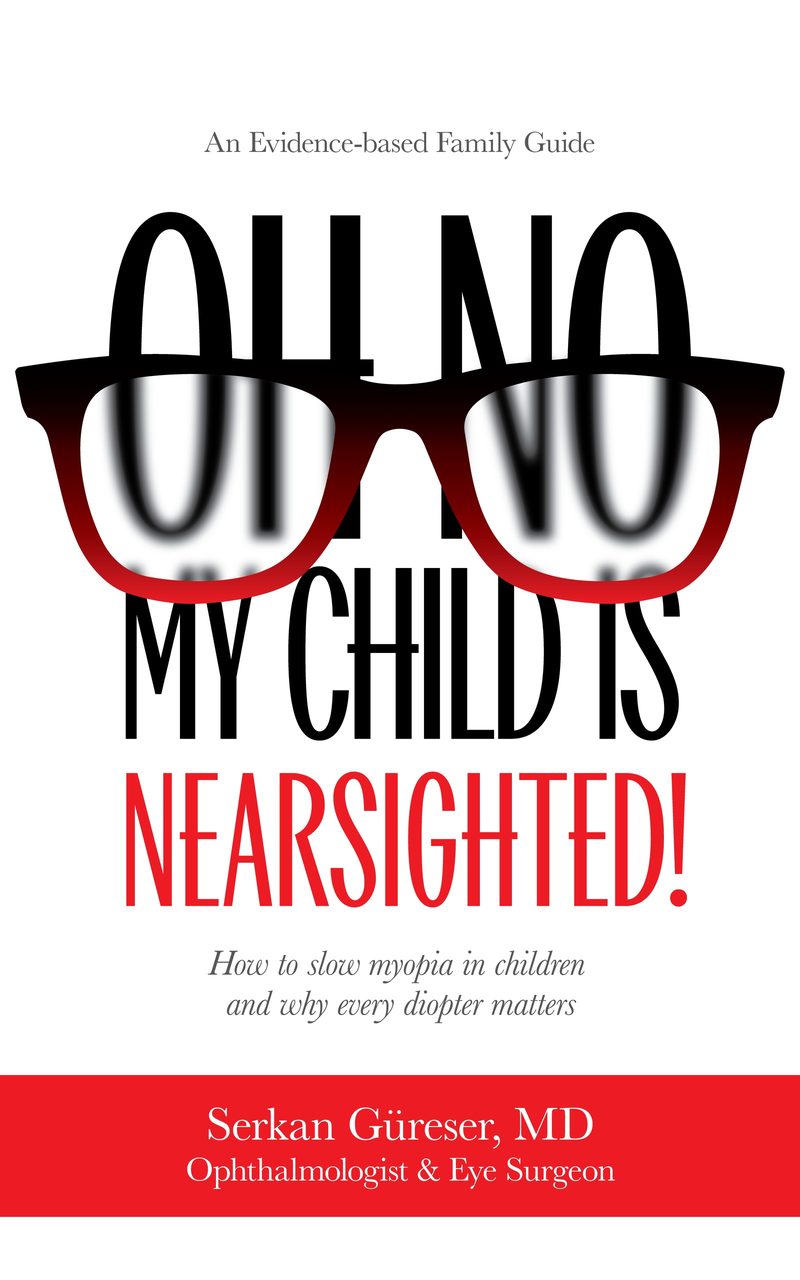
An Evidence-Based Family Guide to Slowing Myopia in Children
An evidence-based, independent family guide to slowing myopia progression in children.
No brand promotion, no advertising. Independent and evidence-based, written by a practicing ophthalmologist.
Kindle e-book
Get it on Amazon Kindle →Kindle edition · 89 pages · published 11 September 2026. Opens on Amazon.com.
This book is a starting point. The right method is decided together with a clinician who examines your child and reviews the measurements. If you're in Ankara, our door is open.